
Over the past several years in my OPD, I have seen a clear pattern among patients and families from Haryana and Rajasthan – early signs of Parkinson’s disease are often dismissed as “just old age.” And by the time a proper diagnosis happens, months, sometimes a full year, have already passed. I am Dr. Kavindra Singh, a neurosurgeon in Narnaul, and in this piece I want to explain plainly what I tell patients – without creating fear about Parkinson’s disease treatment.
How Common Is Parkinson’s Disease: Globally and in India
According to the Global Burden of Disease (GBD) study, roughly 11.77 million people worldwide were living with Parkinson’s disease in 2021 – a 274% increase since 1990. That makes it one of the fastest-growing neurological conditions globally, ahead even of stroke in rate of increase.
A more recent projection published in BMJ estimates that number will rise to around 25 million by 2050, a 112% increase from 2021. Notably, the largest share of that growth is expected in East Asia and South Asia – which includes India.
That means advanced Parkinson’s disease treatment is no longer something patients need to travel to Delhi or Chandigarh for by default.
Smaller cities like Narnaul in Haryana, where I work, are seeing the same rise in cases. The real gap here is awareness and timely diagnosis, not availability of care.
In my practice of more than a decade, I would estimate at least a third of patients first consult me a year or more after symptoms began. That comes often after trying general physicians or assuming nothing serious was wrong.
Early Signs of Parkinson’s Disease That Are Often Overlooked
By the time most patients reach me, the disease has usually been present for a year or longer. Recognising the first warning signs of Parkinson’s is crucial.
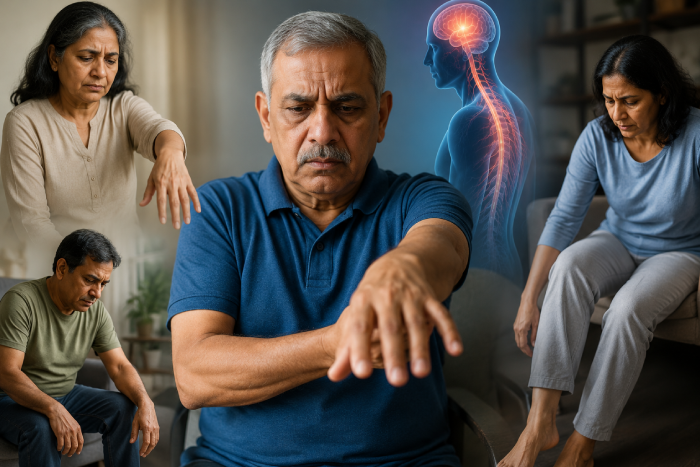
Some of the most common early signs of Parkinson’s disease that families tend to miss:
- A mild tremor in one hand or the fingers – especially at rest, not during activity
- Slowness of movement (bradykinesia) – shorter steps, reduced arm swing while walking
- Stiffness in the body (rigidity), often more noticeable in the morning
- Handwriting gradually getting smaller (micrographia)
- Reduced facial expression, which families often mistake for anger or sadness
- Sleep changes, constipation and reduced sense of smell – these non-motor symptoms often appear before the motor symptoms do
- A soft or quiet voice that changes gradually, often noticed by family before the patient notices it themselves
Also, read my blog – हाथ क्यों कांपते हैं? कंपन (Tremor) के वो कारण जिन्हें कभी नज़रअंदाज़ न करें to understand hand tremor causes and treatment.
Parkinson’s vs. Normal Age-Related Changes: How to Tell the Difference
This is one of the most common points of confusion I see. Normal aging can bring some slowness and occasional stiffness, but a few features point more specifically toward Parkinson’s rather than ordinary aging:
| Normal Aging | More Suggestive of Parkinson’s |
| Slower movement on both sides equally | Symptoms often start on one side of the body |
| Occasional stiffness after rest, improves with movement | Stiffness persists and tremor appears at rest |
| Handwriting stays roughly the same size | Handwriting progressively shrinks |
| No change in facial expression | Reduced blinking, “masked” facial expression |
| Voice stays steady | Voice becomes softer or monotone over time |
If an elderly family member is showing one-sided symptoms, a resting tremor, or a combination of several signs above, a Parkinson’s disease diagnosis by a neurologist – rather than waiting to “see if it gets worse” – is the right next step.
What Is Deep Brain Stimulation (DBS) for Parkinson’s Disease
Deep brain stimulation uses thin electrodes, linked to a chest brain pacemaker, to calm abnormal movement signals. This is the question I get asked most often – “Is DBS right for every Parkinson’s patient?” The honest answer: no. DBS treatment isn’t for everyone and that’s exactly what I tell each patient directly, before any surgical conversation begins.
Parkinson’s Disease – When Does DBS Actually Help
DBS for Parkinson’s tends to be appropriate when:
- A patient responded well to medication (like Levodopa) initially. But now experiences unpredictable “on-off” fluctuations in effect
- Dyskinesia (involuntary movements caused by medication side effects) has become disabling
- Parkinson’s disease is still primarily motor (tremor, stiffness, slowness) without significant cognitive decline or dementia
- The patient is otherwise medically fit for a surgical procedure
DBS सर्जरी is generally not appropriate when:
- Dementia or significant cognitive/psychiatric symptoms are already present
- The diagnosis is actually atypical parkinsonism (a different condition that mimics Parkinson’s but doesn’t respond the same way)
- The patient is very elderly or has other serious health conditions where surgical risk outweighs benefit
A Deep Brain Stimulation decision should always come from a multidisciplinary evaluation – neurologist & neurosurgeon together – not a single doctor’s opinion alone.
I follow this process with every DBS surgery candidate/patient and any specialist recommending DBS without this kind of joint evaluation is skipping a step that exists for patient safety.
क्या भूलना सिर्फ उम्र का असर है या दिमाग की बीमारी? Forgetfulness is often brushed off as aging. This blog explains when memory loss needs a brain specialist’s attention.
Parkinson’s – What to Expect After DBS Surgery
Patients and families often ask what life looks like after the procedure, so here’s a realistic picture:
- Immediate recovery: Most patients are observed in hospital for a few days post-surgery before discharge.
- Device activation: The stimulator is usually not switched on immediately – there’s a healing period first, followed by gradual DBS programming adjustments over several follow-up visits.
- Medication adjustment: DBS does not eliminate the need for Parkinson’s medication, but many patients see their required dosage reduce significantly, which in turn reduces dyskinesia.
- Realistic expectations: DBS primarily improves motor symptoms – tremor, stiffness and medication-response fluctuations. It does not reverse the underlying disease progression and it does not meaningfully treat non-motor symptoms like memory or mood changes.
- Ongoing care: Programming adjustments and medication review continue for months after surgery – this isn’t a one-time fix and follow-up access matters as much as the surgery itself.
Cost and Accessibility for Parkinson’s – Patients in Haryana
This is a real, practical concern for most families and I would rather address it directly than avoid it.
DBS surgery costs in Haryana, India vary considerably depending on the hospital, device type and whether single- or dual-lead systems are used.
So, patients should get a detailed, itemized estimate directly from the treating hospital rather than relying on rough figures online. Government schemes and health insurance coverage vary by eligibility and policy. So it’s worth checking your specific coverage before ruling the option out.
Practical Guidance for Patients Searching for a Neurologist Near Narnaul
Patients come daily to me from Narnaul, Mahendragarh, Rewari, Bhiwani, Charkhi Dadri and Jhajjar…and also from nearby places in Rajasthan like Neemrana.
The biggest issue is almost always delay – not a lack of available treatment. Timely evaluation, accurate diagnosis and access to movement disorder specialist care, including DBS surgery when appropriate, are no longer out of reach for this region.
If an elderly family member is showing these signs:
- Don’t dismiss them as simply “old age”
- Get an early evaluation from a neurologist/neurosurgeon near Narnaul or your nearest movement disorder specialist
- If medication has already started and its effect is becoming inconsistent, discuss DBS early – waiting too long can reduce the benefit of surgery
- Bring a family member to the consultation – they often notice symptom patterns the patient themselves hasn’t registered
Unsure whom to see first? Read Neurologist vs Neurosurgeon: क्या है फर्क.
My Advice to Caregivers
Parkinson’s affects families, not just patients. A few things I tell Parkinson’s caregivers directly:
- Keep a simple symptom diary (when tremors happen, medication timing, good/bad days) – it helps enormously during consultations.
- Falls risk increases as rigidity progresses. So, fall prevention at home (installing railings, removing loose rugs) is worth doing early.
- Non-motor symptoms – depression, anxiety, sleep disruption – are common and treatable. But patients often don’t mention them unless directly asked.
Summing it Up….
Parkinson’s disease is a lifelong condition, but with timely diagnosis and the right Parkinson’s disease treatment plan, patients can maintain a good quality of life for years.
DBS isn’t a solution for everyone. But for the right patient and if evaluated through a proper multidisciplinary process, it can be genuinely life-changing.
If you or someone in your family is experiencing these symptoms, timely consultation – not waiting to “see if it gets worse” – matters most in managing this disease. If you have more queries, you can meet me in person. Book an appointment to meet me.
Frequently Asked Questions
- What are the early signs of Parkinson’s disease?
The early signs of Parkinson’s disease include a mild resting tremor in one hand, slowness of movement, stiffness, smaller handwriting, reduced facial expression and a softer voice. Sleep changes, constipation and a reduced sense of smell can appear even before these motor symptoms. - How is Parkinson’s disease different from normal aging?
Normal aging slows movement on both sides equally and handwriting stays the same size. Parkinson’s often starts on one side, brings a tremor at rest, shrinks handwriting and reduces blinking and facial expression. If several of these appear together, see a neurologist. - Is hand tremor always a sign of Parkinson’s disease?
No. Hand tremors can result from essential tremor, certain medicines, thyroid problems, low blood sugar, stress and other conditions. A tremor that persists, worsens or occurs alongside stiffness or slowed movement should be medically assessed. - Who is a good candidate for DBS surgery in Parkinson’s disease?
DBS surgery suits patients who first responded well to Levodopa but now face unpredictable on-off fluctuations or disabling dyskinesia, with mostly motor symptoms and no significant dementia. A neurologist, neurosurgeon and psychiatrist should decide together after a multidisciplinary evaluation. - What is the average Deep Brain Stimulation(DBS) surgery cost in Haryana and India?
The cost of DBS surgery in Haryana, India varies by hospital, device type, and whether a single- or dual-lead system is used. Ask the treating hospital for a detailed, itemized estimate and check your health insurance and government scheme eligibility before deciding. - Does Deep Brain Stimulation cure Parkinson’s disease?
No. Deep Brain Stimulation(DBS) improves motor symptoms such as tremor, stiffness and medication-response fluctuations, and many patients need lower medicine doses afterwards. It does not reverse disease progression or meaningfully treat memory or mood changes, so ongoing programming and medication review remain essential. - Where can I find a neurosurgeon or neurologist for Parkinson’s disease near Narnaul?
Dr. Kavindra Singh sees Parkinson’s patients at Rainbow Multispeciality Hospital & Trauma Centre, Narnaul, Haryana. Families also travel from Mahendragarh, Rewari, Bhiwani, Charkhi Dadri, Jhajjar and Neemrana in Rajasthan. You can also explore neurological care services on the website.
About the Author
Dr. Kavindra Singh is an AIIMS and PGI trained neurosurgeon practising at Rainbow Multispeciality Hospital & Trauma Centre, Narnaul, Haryana. Specializing in complex brain procedures, movement disorders, and Deep Brain Stimulation (DBS), Dr. Singh is dedicated to bridging the gap in neurological care for smaller cities and ensuring patients receive timely, multidisciplinary treatment for Parkinson’s disease and other neurological conditions. He treats brain, spine and nerve conditions, for patients across Haryana and nearby Rajasthan.
Medical Disclaimer: This article is for general informational purposes and is based on ICMR clinical guidelines and published WHO/GBD epidemiological data. It is not a substitute for professional medical advice, diagnosis, or treatment. Please consult a qualified neurologist directly for any individual medical decision.