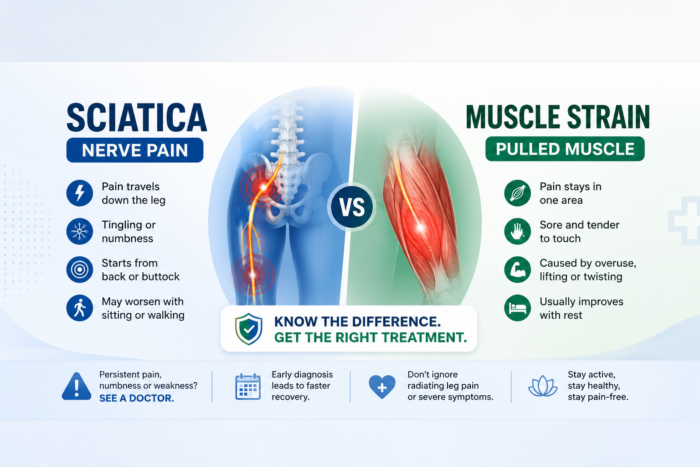
Every week in my hospital, I meet patients from Haryana who say the same thing: “Doctor saab, I thought it was just muscle pain.”
Some come after months of applying oils, taking painkillers or doing local massages. Others ignore the pain because they think they “pulled a muscle” while lifting something heavy, driving long distances or sitting continuously during office work. By the time they finally visit me, the pain has already started affecting their walking, sleep, work and confidence.
What worries me most is this: many people fail to recognize the difference between sciatica vs muscle strain . That delay can sometimes worsen nerve irritation and make recovery slower.
Low back pain with sciatica symptoms is now one of the leading causes of disability worldwide. Global medical research published in Annals of the Rheumatic Diseases showed that low back pain ranks among the top causes of disability across the world. Today as the top spine specialist in Haryana, I will share how to identify the two types of pain and how to overcome the same.
What Exactly Is Sciatica?
Sciatica is not just “normal leg pain.” It happens when the sciatic nerve — the longest nerve in the body — gets irritated or compressed. It is usually because of a slipped disc, spinal degeneration or narrowing around the nerves also referred to as foraminal stenosis in medical terminology.
Leg pain due to nerve compression? The nerve pain typically starts in the lower back or buttock and travels down one leg. Many patients describe it as:
- Burning pain
- Electric shock sensation
- Tingling or pins and needles
- Sudden shooting pain
- Numbness in the leg or foot
Medical studies show that sciatica affects nearly 3–5% of the general population and the condition is most commonly linked with lumbar disc problems at L4-L5 or L5-S1 spinal levels.
What Is a Leg Muscle Strain?
Leg pain nerve vs muscle pain? A leg muscle strain is completely different. This happens when muscles or tendons get overstretched or partially torn due to physical activity, gym injury, sports movement climbing stairs excessively or sudden twisting. Unlike sciatica, muscle strain pain usually stays localized in one area. The pain feels sore, tight or cramp-like rather than electric or burning. In most cases, muscle strain improves gradually with rest, hydration, physiotherapy and temporary activity modification.
But low back pain with leg pain behaves differently. That is where people become confused.
Sciatica vs Muscle Strain – How to Identify Nerve Pain in Leg?
One of the easiest ways I help patients identify sciatica is by asking this question: “Does the pain travel?”
If the pain starts in the back or hip and shoots downward below the knee toward the calf or foot, it strongly suggests nerve involvement. Medical literature on lumbar radiculopathy clearly states that sciatica pain commonly travels below the knee and follows the path of the compressed nerve root.
Muscle strain generally stays in one spot.
So what are the sciatica vs pulled muscle symptoms?
Here is a simple comparison I often explain at Rainbow Hospital, Narnaul Haryana:
| Symptom | Sciatica Pain Symptoms | Muscle Strain Pain Symptoms |
|---|---|---|
| Type of Pain | Sharp, burning, electric shock-like | Dull, sore, tight, aching |
| Pain Starts From | Lower back or buttock | Directly in muscle area |
| Pain Travels Down Leg? | Yes, often reaches thigh, calf, or foot | Usually stays in one spot |
| Numbness or Tingling | Common | Rare |
| Muscle Weakness | May happen in leg or foot | Mild weakness due to pain only |
| Pain While Sitting | Often worse | Usually better with rest |
| Pain While Walking | Can increase after some distance | Pain only when muscle moves |
| Touching Area | Usually no major tenderness | Muscle feels painful to touch |
| Sudden Injury History | May or may not happen | Common after lifting, exercise, twisting |
| Morning Stiffness | Possible | Common |
| Relief With Rest | Sometimes not relieved | Usually improves |
| Coughing/Sneezing Pain | Can worsen pain | Usually no effect |
| Best Described As | “Nerve shooting down leg” | “Pulled or tight muscle” |
| When to See Doctor | If numbness, weakness, or severe leg pain | If swelling, severe pain, or no improvement |
Sciatica Symptoms in Leg You Should Never Ignore
Many people in Haryana continue working despite severe symptoms because they assume it is “normal body pain.” Unfortunately, ignoring nerve compression can sometimes increase damage around the affected nerve.
I strongly advise patients to seek medical evaluation if they notice:
-
- Pain radiating below the knee, sharp shooting pain down the leg
- Tingling or numbness in leg causes sudden balance issues
-
- Difficulty walking properly
- Weakness while climbing stairs
- Burning pain while sitting
- Pain worsening during coughing or sneezing
- Leg pain not improving with rest
- Sleep disturbance due to leg pain
Research published in neurological studies found that many sciatica patients also experience paresthesia, weakness and reduced physical function along with leg pain.
Why Sitting Makes Sciatica Worse
This is something I see especially in drivers, office workers, factory employees and people traveling daily between cities in Haryana. Prolonged sitting increases pressure on spinal discs. If a disc is already bulging, it can irritate nearby nerves more aggressively.
That is why many sciatica patients tell me:
- “Pain increases while driving.”
- “I cannot sit for long.”
- “The leg starts burning after 15 minutes.”
Muscle strain usually behaves differently. Mild movement may hurt initially, but the pain often settles gradually instead of radiating downward.
Can Sciatica Heal Without Surgery?
Yes — many cases improve with early diagnosis, physiotherapy, posture correction, medicines and lifestyle modification.
But the timing matters. Several patients come to me after trying random treatments for months. By then, the nerve irritation becomes chronic and recovery takes much longer.
Medical evidence suggests that persistent sciatica can continue for months or even years in some individuals if not managed properly. This is why early evaluation is important by the best neurosurgeon in Narnaul, Haryana.
The Most Dangerous Mistake I See
The biggest mistake is self-diagnosis.
People assume:
- “It is calcium deficiency.”
- “It is weakness.”
- “It is age-related.”
- “Massage will fix it.”
But if the real issue is nerve compression inside the spine, temporary pain relief may hide the condition while the nerve keeps suffering silently.
I have seen young professionals, gym-goers, farmers, teachers and even athletes struggle because they delayed proper spine assessment.
How Best Neurosurgeon Narnaul Evaluates Sciatica in Patients
When a patient visits me with suspected nerve pain, I carefully assess:
-
- Pain pathway
- Muscle strength
- Reflexes
- Walking pattern
- Numbness areas
- Spine movement
- Straight leg raising test
- Lower back pain radiating to leg and not getting under control
If needed, imaging studies like MRI help identify disc bulges or nerve compression accurately. The goal is not only pain relief, it is preventing long-term nerve dysfunction via the best Sciatica treatment in Haryana.
When to See a Spine Doctor for Nerve Compression Symptoms?
Please do not delay consultation if you experience the following sciatica symptoms in leg:
- Severe leg weakness
- Foot drop
- lower back pain radiating to legLoss of bladder or bowel control
- Increasing numbness
- Progressive walking difficulty
You can also read my article here on Slip Disc Vs Back Pain.
Critical Advice to Haryana Patients
I assure you the best Sciatica treatment in Haryana, near Mahendergarh and other areas around Narnaul. We also specialise in herniated disc treatment, if the condition has worsened.
A timely spine evaluation can make all the difference between quick recovery and months of suffering. Considering I am the most trusted spine specialist in Haryana, I suggest you do not delay and click the link to book an appointment. You can check below from which all locations of Haryana or nearby Metros you can reach me. CLICK HERE TO BOOK APPOINTMENT
Patients come to Dr Singh from Haryana, Rajasthan, Punjab and beyond. Sitting at Narnaul at Rainbow Multi-speciality Hospital, Dr. Kavindra Singh has been serving patients across Haryana in all its rural areas as well as cities like Mahendargarh, Rewari, Rohtak and more. And now even accessible in nearby places in both Haryana and Rajasthan like Dharuhera, Bawal, Ateli, Kanina, Kosli, Charkhi Dadri, Bhiwani, Loharu, Jhajjar, Alwar, Behror, Kotputli, Neemrana, Pilani, Chirawa, Singhana and Khetri. The idea is that affordable brain, nerve and spine care reaches all, without going to farther cities like Jaipur, Chandigarh or Gurgaon.