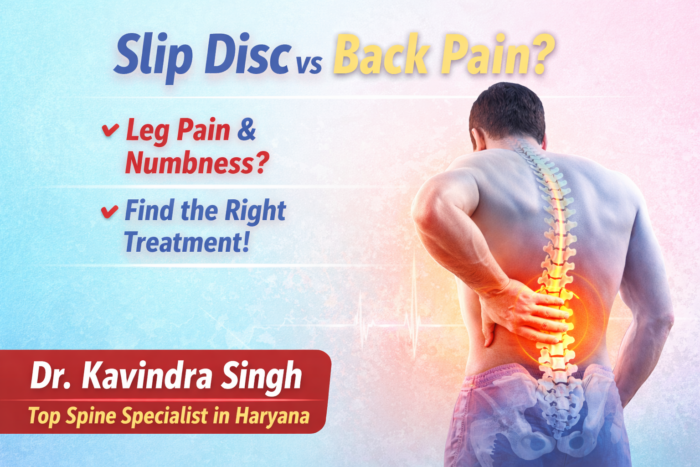
Every year, over 619 million people globally suffer from lower back pain, making it the leading cause of disability worldwide (WHO). In India, cases of spinal disorders are rising sharply due to sedentary lifestyles and long sitting hours.
Yet, one critical mistake continues: People fail to differentiate slip disc vs back pain, delaying the right treatment and risking permanent nerve damage.
It often starts with something simple—a dull ache after a long day, a stiffness after lifting something heavy, or a nagging pain that refuses to go away. Most people brush it off as “just back pain.” But what if it’s something more serious?
As a leading spine specialist in Haryana, Dr Kavindra Singh asserts, “I’ve seen countless patients walk in with what they believed was minor discomfort, only to discover they were dealing with a slip disc.”
This is where understanding slip disc vs back pain becomes critical for preventing long-term damage. And that is where expert intervention from a back pain specialist in Haryana becomes essential.
The Reality Check with a Patient from Rajasthan
Ravi, a 38-year-old working professional from Haryana, ignored his back pain for weeks. It started as mild discomfort but gradually worsened. When pain began shooting down his leg, he panicked. He assumed it was fatigue. It wasn’t. After evaluation, Ravi was diagnosed with a slipped disc and it needed immediate attention. His case is far from rare.
According to global health data, nearly 80% of adults experience back pain at some point in their lives. However, only a fraction realize when it crosses into something serious. This is why identifying the difference between slip disc and normal back pain is essential.
What is Normal Back Pain?
Normal back pain is usually linked to everyday habits and physical strain. For example, muscle strain can happen when someone lifts a heavy water bucket incorrectly and feels a dull ache the next day. Poor posture is common in office workers who sit hunched over laptops for hours, leading to stiffness by evening.
A sedentary lifestyle like minimal movement throughout the day, can cause the back muscles to weaken. This could be resulting in discomfort even after small activities. Sudden movements, such as bending quickly to pick something up, can also trigger temporary pain.
These are among the most common lower back pain causes. In most cases, the pain improves with rest, responds well to basic medication, and stays limited to the back without spreading. However, if you notice back pain not improving after rest, it may indicate something more serious that needs expert evaluation.
What is a Slip Disc?
A slip disc (or herniated disc) occurs when the soft cushioning between spinal bones slips out and presses against nearby nerves.
This is where understanding herniated disc vs muscle pain becomes crucial. Unlike muscle strain, a slip disc:
- Affects nerves
- Causes radiating pain
- Can lead to numbness or weakness
| Factor | Back Pain (Normal) | Slip Disc (Herniated Disc) |
|---|---|---|
| Cause | Muscle strain, poor posture, fatigue | Disc bulge pressing on nerves |
| Type of Pain | Dull, aching, localized | Sharp, shooting, severe |
| Pain Location | Limited to lower back | Starts in back, radiates to legs |
| Pain Movement | Does not travel | Often causes leg pain due to slipped disc |
| Nerve Involvement | No nerve compression | Clear signs of nerve compression in back |
| Associated Symptoms | Stiffness, mild discomfort | Numbness, tingling, weakness |
| Sciatica Symptoms | Absent | Common (pain down one leg) |
| Recovery Time | Improves in days to weeks | May persist or worsen without treatment |
| Response to Rest | Improves with rest | Often back pain not improving after rest |
| Severity Level | Usually mild to moderate | Can become severe and disabling |
| Treatment Needed | Rest, physiotherapy, medication | May require advanced care or surgery |
| When to Worry | If persistent beyond 2 weeks | Immediate attention required |
| Specialist Required | General physician/physio | Neurosurgeon for slip disc in Haryana |
Slip Disc Symptoms You Should Never Ignore
Many patients wait too long because they don’t recognize early slip disc symptoms. Watch for following slip disc symptoms:
- Persistent lower back pain
- Pain radiating to legs
- Numbness or tingling
- Muscle weakness
- In many cases, patients develop sciatica symptoms, where pain travels from the lower back down one leg.
When Back Pain Becomes Serious – Another Real-Life Example
Suresh, a 42-year-old shop owner from Gurgaon in Haryana, initially ignored his back pain. He was assuming it was due to long working hours. But unlike earlier episodes, this time the pain didn’t fade. It persisted beyond three weeks, gradually increasing in intensity. Soon, he found it difficult to stand for long hours at his shop. And even walking short distances became uncomfortable. The most alarming moment came when he started experiencing slight numbness in his leg—clear signs of nerve compression in back.
This is exactly when back pain becomes serious and when to see a spine surgeon without delay.
In Suresh’s case, what could have been managed early turned into a more complex condition requiring advanced care. Ignoring such warning signs can easily turn a manageable issue into one that may need surgical intervention.
How Slip Disc is Diagnosed?
Accurate diagnosis is the difference between relief and long-term suffering. This helps identify even early signs of nerve compression in back, ensuring timely treatment. At his center, Dr Kavindra Singh uses:
- Detailed clinical evaluation
- MRI imaging
- Neurological assessment
Dr. Kavindra Singh, serving patients across Narnaul, Mahendergarh, Singhana, Buhana, Ateli, Neemrana, Nangal Choudhary and Kanina in Haryana plus nearby regions of Rajasthan like Neemrana, Behror, etc. CLICK HERE TO CONTACT HIM TODAY
Treatment From Back Pain to Recovery
For Regular Back Pain
Most cases improve with:
- Rest and physiotherapy
- Posture correction
- Medication
For Slip Disc
Treatment depends on severity:
- Non-surgical management
- Advanced pain therapies
- Surgery in critical cases
As the best doctor for slip disc treatment in Haryana, Dr. Kavindra Singh’s focus is always on avoiding surgery unless absolutely necessary.
Why Expertise Makes All the Difference
Not every case needs surgery—but when it does, the right hands matter.
Recognized as a best spine surgeon in Haryana, Dr Kavindra Singh is known for:
- Precise diagnosis
- Ethical treatment decisions
- High success rates
Patients across Haryana and nearby regions trust him as a leading Neurosurgeon for slip disc in Haryana.
Take the Next Step Toward Relief
If you’re searching for right guidance towards slip disc vs back pain, connect with Dr. Kavindra Singh, before your condition worsens. Early diagnosis can save you from surgery. Right treatment can restore your normal life.
Consult Dr Kavindra Singh today by clicking this link. Start your journey to a pain-free future.
FAQs
1. What is the main difference between slip disc vs back pain?
Back pain is usually muscular and temporary, while a slip disc involves nerve compression and causes radiating pain.
2. What are early slip disc symptoms?
Common slip disc symptoms include lower back pain, numbness, tingling, and pain radiating to the legs.
3. When should I see a spine specialist?
If pain lasts more than 2 weeks or shows sciatica symptoms, consult a back pain specialist in Haryana immediately.
4. Can slip disc heal without surgery?
Yes, many cases improve with non-surgical chronic back pain treatment if diagnosed early.
5. Who is the best doctor for slip disc in Haryana?
For expert care, consult Dr Kavindra Singh, a trusted neurosurgeon in Haryana.