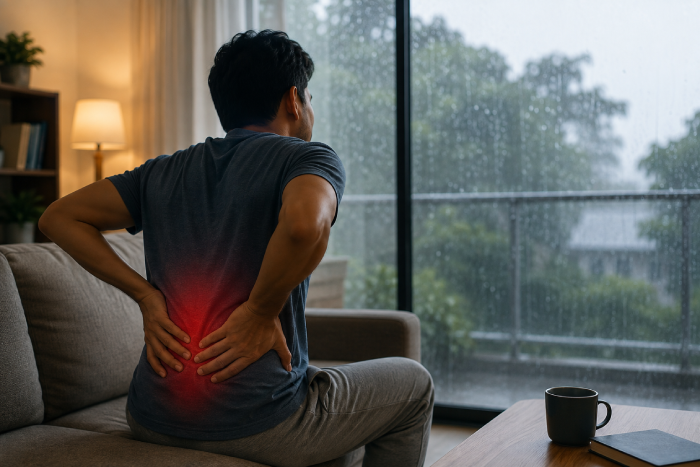
Every rainy season, many patients ask me about managing back pain in monsoon. I hear a familiar complaint from patients across Haryana:
“Doctor, my back pain was manageable before the rains. Why has it suddenly become worse?”
Patients from Narnaul, Mahendragarh, Rewari, Ateli, and nearby areas often notice more stiffness, discomfort or difficulty moving during rainy days. Some even feel that an old slip disc or sciatica has suddenly “come back”.
But there is an important point I want every patient to understand.
Rain itself does not automatically damage your spine.
Medical research has not established that humidity, rainfall or atmospheric pressure directly causes low back pain. A 2024 systematic review and meta-analysis involving 15,315 participants and more than 28,000 musculoskeletal pain events found no significant association between weather factors and the risk of low back pain.
A systematic review and meta-analysis of 97 studies found that low back pain is highly common in India. The pooled prevalence was approximately 48% at a given point, 51% over one year and 66% over a lifetime. The researchers also found higher prevalence among rural populations and elementary workers.
For Haryana patients, this is important because back pain should not automatically be dismissed as a temporary monsoon complaint.
The weather may simply be when you notice the problem. It may not be the actual cause. If you already have a spine problem, slip disc, sciatica or nerve compression, a change in activity, posture or physical workload during the rainy season can make your symptoms more noticeable.
So why do some people genuinely feel worse during monsoon? Today, I …Dr. Kavindra Singh– Neuro and Spine Super Specialist and Surgeon, will explain to you what I see in clinical practice.

Why Back Pain in Monsoon Can Feel Worse
1. You May Become Less Physically Active
This is one of the most practical explanations.
When it rains continuously, people often spend more time indoors. Morning walks are skipped. Outdoor exercise decreases. Patients who normally stretch, walk or exercise regularly may suddenly become much less active.
That change can increase stiffness and make existing lower back pain feel worse.
For example, I had a case from Narnaul, Haryana, who normally walked every morning. But he spent several rainy days indoors. When that person finally returns to normal activity, the lower back may feel unusually tight. The weather may not be “damaging” the spine.
The change in movement may be contributing to the discomfort.
2. Stiffness Can Make Existing Pain More Noticeable
Some patients associate damp weather with increased joint or musculoskeletal discomfort.
Research on osteoarthritis has found associations between weather conditions and pain in several studies, although the relationship is complex and does not prove that weather directly causes pain.
This distinction matters. If you already have age-related spinal changes, disc problems or another musculoskeletal condition, you may notice symptoms more during periods when your routine, movement and environment change. The rainy season can therefore make an existing problem feel more prominent, causing a flare-up of back pain in monsoon without being its underlying cause.
3. Long Periods of Sitting can Aggravate Back Pain
This is especially relevant today.
During heavy rain, many people sit for longer periods at home, in offices or while working remotely. Sitting in one position for hours can aggravate existing back pain. I see this particularly among office workers and people who drive long distances between towns such as Mahendargarh, Dharuhera and Narnaul.
The problem is not simply the rain. It is the combination of less movement, prolonged sitting and an already vulnerable back.
4. Old Spine Problems May Become Noticeable Again
A patient with a previous slipped disc, nerve compression or chronic lower back pain may have periods when symptoms are mild.
Then a combination of reduced activity, prolonged sitting, awkward posture, lifting or sudden physical effort can trigger a flare.
For example, a person in Mahendragarh spent several days resting indoors during heavy rain. Then one day he suddenly lifted a gas cylinder, bucket or heavy household item. That sudden load produced a significant spinal flare. It is easy to blame the weather. But the spine often tells a more complicated story.
Back Pain in Monsoon: Could It Be a Slip Disc or Sciatica?
This is one question I am frequently asked by patients with recurring lower back pain.
A slipped or herniated disc can sometimes irritate a spinal nerve. When this happens, the pain may travel from the lower back into the buttock and leg. Patients may also experience tingling, numbness or weakness. This is commonly described as sciatica or radicular pain. Read my article on Slip Disc VS Back Pain– Top Symptoms.
So, if your monsoon back pain is travelling down one leg rather than remaining only around the lower back, I would not simply blame humidity or rain. I would like to know whether there is an underlying nerve compression or other spine condition. And for that, you need to meet me or book an appointment.
Is Monsoon Back Pain Always Harmless?
No. This is where I want Haryana patients to be particularly careful.
Back pain is extremely common. The World Health Organization reports that low back pain affects approximately 619 million people worldwide and is the leading cause of disability globally. The number is projected to rise to 843 million by 2050. About 90% of low back pain is classified as non-specific.
But not every case is simple muscular pain.
If your back pain is accompanied by pain travelling into the leg, numbness, tingling, weakness, difficulty walking or worsening symptoms, I would not recommend simply waiting for the monsoon to pass.
These symptoms can sometimes indicate nerve involvement, including lumbar radiculopathy. More importantly, new bladder or bowel problems, significant weakness or other neurological symptoms require urgent medical assessment. NICE specifically highlights new bladder or bowel disturbance and weakness among symptoms requiring appropriate neurological evaluation.
When Should You See a Spine Specialist?
The important question is: What is actually causing the pain? I would encourage you to seek advice, go for the trusted spine specialist near me in Haryana, for assessment when your back pain:
- You slipped in rain or a wet surface and have ignored the pain, via self medication or just by taking pain killers from a chemist
- keeps returning or is progressively worsening
- spreads from your back into the buttock or leg
- causes numbness, tingling or burning
- causes weakness in the leg
- makes walking or standing difficult
- interferes with sleep or daily activities
- continues despite appropriate treatment
Patients from Ateli, Kanina, Singhana, Rewari and Mahendragarh do not need to assume that persistent back pain is simply a “monsoon problem”.
I provide brain, spine and nerve care at Rainbow Multispeciality Hospital & Trauma Centre, Narnaul, serving patients from Haryana and nearby regions. My approach is to understand the cause of the problem first and recommend treatment according to the patient’s actual condition. Surgery or any such critical treatment is not done unless really required. Read my article on – Back Pain, Spine Pain Not Improving – Top Neurosurgical Options Explained
Do You Need an MRI for Back Pain?
Not every case of lower back pain needs an MRI. If you are seeking back pain treatment in Haryana, I recommend proper clinical and neurological assessment first. MRI may be advised for suspected slip disc, sciatica, nerve compression, persistent pain or neurological symptoms. The scan should answer a clinical question, not replace examination.

What Can You Do for Back Pain in Monsoon Relief?
I usually advise my patients not to become completely inactive.
- Keep moving gently throughout the rainy season.
- Use a warm compress for stiff muscles.
- Try gentle stretches without forcing painful movements.
- Avoid prolonged sitting in one position.
- Maintain proper posture while working indoors.
- Take short walks whenever weather safely permits.
- Support your lower back while sitting.
- Avoid sudden bending, twisting, or heavy lifting.
- Sleep comfortably with adequate back support nightly.
- Seek medical advice if pain keeps worsening.
WHO’s guidance for chronic primary low back pain emphasizes appropriate education, physical interventions and other evidence-based non-surgical approaches rather than relying on a single treatment for everyone.
Looking for Back Pain मानसून Treatment in Haryana?
I am sure, if you are reading this, you have been searching for back pain treatment, sciatica treatment or a spine specialist in Haryana. If your back pain is worsening, recurring or travelling into your leg, I would rather assess the cause early than have you keep waiting for the pain to disappear on its own.
Patients from Narnaul, Mahendragarh, Rewari, Ateli, Kanina, Singhana and surrounding areas come to me and seek an appropriate spine evaluation rather than continuing to wait for the monsoon to end. So do not wait, CLICK THE LINK TO MEET ME.
ABOUT THE AUTHOR
Dr. Kavindra Singh is a highly qualified neurosurgeon in Narnaul, Haryana, with specialized training from prestigious institutions like AIIMS Delhi and PGIMER Chandigarh. As a premier brain and spine specialist, he is dedicated to the expert management of stroke, spinal issues, and nerve-related disorders. He believes in the power of knowledge and regularly shares insights to help patients understand neurological symptoms and the importance of early intervention. If you are seeking advanced neurological care in Narnaul and surrounding areas, you can visit him at Rainbow Multi Speciality Hospital for a comprehensive evaluation and a customized path to recovery.
Medical Disclaimer: This article has been published to educate the masses. Do not attempt self-care or self-medication at home. Consult a qualified doctor only.