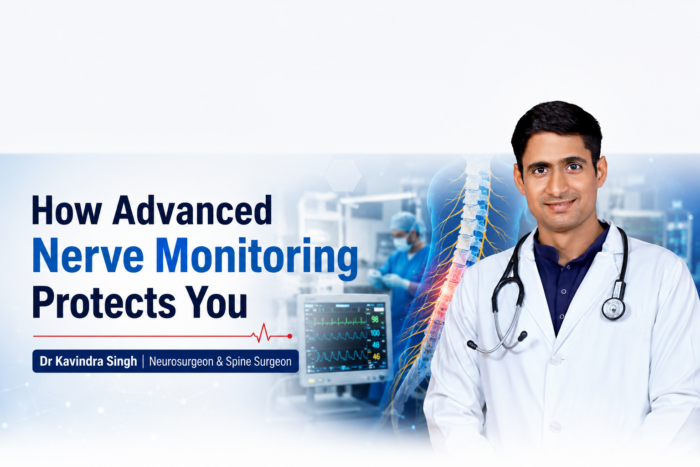
If you have been advised about spine surgery, one question naturally comes to mind: “How will my nerves and spinal cord stay safe during the operation?”
A common question I am asked, even by my allied medical assistants and not just patients: Why Advanced Neuro-Monitoring During Spine Surgery Is Essential for Safety
As a neurosurgeon for spine surgery, I hear this concern almost every day from patients visiting from Narnaul, Mahendragarh, Ateli, Kanina, Rewari, and nearby areas in Haryana.
A 58-year-old farmer from Kanina recently asked me the same question before his surgery. His biggest fear was not the procedure itself. It was waking up with weakness in his legs. This is exactly where advanced neuro-monitoring becomes important.
What Is Advanced Neuro-Monitoring?
This technology, also known as Intraoperative Neurophysiological Monitoring (IONM), is widely used for spinal cord protection during surgery. Your spinal cord is like the main electrical highway connecting your brain to the rest of your body. Every movement, each sensation, every signal…travels through this pathway.
During certain spine surgeries, surgeons work extremely close to these delicate structures. Advanced neuro-monitoring continuously tracks these signals while surgery is being performed. Special equipment checks whether the spinal cord and nerves are transmitting signals normally.
If there is any unexpected change, the surgical team receives an immediate alert. This real-time assessment is one reason Intraoperative Neurophysiological Monitoring (IONM) is widely used in higher-risk spine procedures. Research shows it helps detect potential neurological compromise while surgery is still underway.
Why Advanced Neuro Monitoring?
If you are undergoing spine surgery, advanced neuro-monitoring acts like a real-time safety system for your spinal cord and nerves. It continuously checks nerve function during surgery and alerts the surgical team if any changes occur. This additional layer of protection helps improve spine surgery safety, supports nerve damage prevention surgery, and can reduce the risk of neurological complications during selected spine procedures.
Studies show that Intraoperative Neurophysiological Monitoring helps surgeons detect potential nerve injury early and respond before permanent damage occurs.
As an experienced spine specialist in Haryana, I believe patients deserve clear answers. One of the biggest advances that has improved spine surgery safety over the years is advanced neuromonitoring. It allows us to monitor nerve function throughout surgery instead of waiting until the procedure is over to know whether the nerves remained healthy. As a dedicated spine surgeon in Haryana, I ensure this technology is available to minimize patient anxiety.
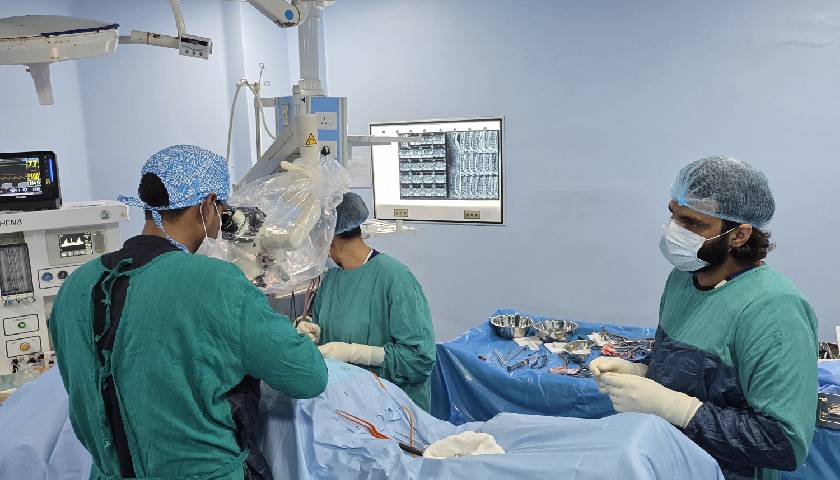
Benefits of Nerve Monitoring During Spine Surgery
Many patients assume surgery is simply about fixing a slipped disc or decompressing a nerve.
In reality, protecting neurological function is equally important. Advanced nerve monitoring during spine surgery has become an important part of safer spine surgery techniques and modern advanced spine care that Haryana patients deserve.
A retired teacher from Mahendragarh recently came to me with severe cervical myelopathy. She was losing balance while walking. Her spinal cord was already under pressure. In such cases, protecting nerve function during surgery becomes a major priority. Spinal cord monitoring provides an added layer of safety. The monitoring team continuously watches how the spinal cord responds during the procedure. Instead of discovering a problem afterwards, we can identify concerns immediately.
How Does Real-Time Nerve Monitoring Work?
It is very simple, because it is like doing an ECG of the Spine – a totally non-surgical, painless procedure. Before surgery begins, baseline nerve signals are recorded. Throughout the operation, these signals continue to be monitored. If signal strength changes unexpectedly, the surgical team investigates immediately.
Possible reasons may include:
- Excessive traction on a nerve
- Temporary reduction in blood supply
- Pressure on the spinal cord
- Instrument placement requiring adjustment
- Position-related nerve stress
This process is called real-time nerve monitoring. It functions like an early warning system. Research consistently shows that monitoring can identify potential neurological injury before it becomes permanent, allowing corrective action during surgery itself.
Does Neuro-Monitoring Eliminate All Risks?
No, any surgeon who says surgery is risk-free is not being honest.
Every surgery carries some degree of risk. However, advanced technology can help us reduce risk. The goal is not perfection but safer decision-making for long-term life improvement. The goal is to improve spine surgery success rates while reducing the chances of spinal cord injury and long-term neurological complications.
Studies evaluating modern intraoperative monitoring have shown improved detection of neurological compromise and better protection during complex spinal procedures. The greatest benefits are often seen in deformity correction, spinal tumors, and surgeries involving significant spinal cord manipulation.
Patients seeking safe spine surgery treatment specifically must enquire about nerve monitoring, and choosing an experienced neurosurgeon for spine surgery is the first step toward that reassurance.
Which Spine Surgeries Commonly Use Neuro-Monitoring?
Not every patient requires it. The decision depends on the procedure.
Common examples include:
- Cervical spine surgery
- Complex lumbar surgery
- Spinal deformity correction
- Spinal tumor surgery
- Revision spine surgery
- Spinal cord decompression
- Instrumented spinal fixation
These procedures involve structures where spinal nerve protection becomes especially important. Monitoring is commonly recommended when there is an increased risk of neurological injury during surgery. Consulting a qualified spine surgery specialist will help determine if your specific condition warrants this extra layer of protection.
Read here: What cautions to take while recovering from Spine Surgery
What Happens If Nerves Are Injured During Surgery?
This is the fear behind most patient questions. Potential complications may include:
- Weakness in arms or legs
- Numbness
- Walking difficulty
- Balance problems
- Bladder dysfunction
- Rarely, paralysis
The actual paralysis risk during spine surgery depends on the condition being treated, the complexity of surgery, and the patient’s neurological status before surgery. That’s why advanced neuro-monitoring has become such a valuable safety tool. The earlier a warning is detected, the more options surgeons have to respond.
A Haryana Patient Real Life Case
A shop owner from Ateli, Haryana, came to me with severe cervical spinal cord compression. For nearly a year, he believed his symptoms were simply due to age. His hands had become clumsy, plus his walking had slowed. His MRI revealed significant spinal cord pressure. Because of the complexity of the surgery, neurological monitoring was used. During a critical stage of decompression, signal changes were observed.
The surgical team immediately reviewed every step. The signals stabilized, and surgery was completed safely. Today, he is back to managing his business.
Common Myths vs Facts
Myth 1: Nerve Monitoring is only for very dangerous surgeries.
Fact: It is often used whenever important neural structures are at risk.
Myth 2: Neuro Monitoring guarantees zero complications.
Fact: No surgery is risk-free.
Myth 3:Nerve Monitoring replaces surgeon experience.
Fact: It supports surgical judgment. It does not replace it.
Myth 4: Real-time neuro monitoring makes surgery unsafe.
Fact: Monitoring is used specifically to improve patient safety.
Myth 5: Only brain surgeries need advanced neuro monitoring.
Fact: Many spine procedures benefit from monitoring as well.
Why Patients Across Haryana Seek Expert Spine Care from Me
Patients from Narnaul, Mahendragarh, Ateli, Kanina, Rewari, Bawal, Neem Ka Thana, Khetri and surrounding regions often seek expert evaluation from me because I come with expertise from AIIMS Delhi, PGIMER Chandigarh, SGPGIMS Lucknow, as well as AIIMS Rishikesh. So, I deeply examine them when symptoms persist despite medicines and physiotherapy.
Whether someone is searching for the qualified spine surgeon near Narnaul or a low-cost but trusted neurosurgeon in Haryana, my advice remains the same:
- Ask detailed questions.
- Understand your diagnosis.
- Know your treatment options.
- Understand the safety measures being used during surgery.
An informed patient always makes better decisions. As the top spine specialist in Narnaul, Haryana, I believe patient education is one of the most important parts of treatment.
Frequently Asked Questions
Is neuro-monitoring used in every spine surgery?
No, the decision depends on the complexity of the surgery and the structures involved.
Does neuro-monitoring prevent paralysis?
It cannot guarantee prevention, but it helps detect nerve stress early and allows corrective action.
Is neuro-monitoring painful?
No, patients are under anesthesia during surgery.
Does it increase surgery time?
Usually, only minimally, depending on the procedure.
Is it useful in cervical spine surgery?
Yes, because it is commonly used when the spinal cord is at risk.
Can monitoring detect nerve problems immediately?
That is one of its biggest advantages.
Is monitoring useful for tumor surgery?
It is often valuable during spinal tumor procedures where nerve preservation is critical.
Should I ask whether monitoring will be used?
Absolutely. Patients should understand every safety measure planned for their surgery.
My Final Advice for Spine Surgery Care
If you are considering spine surgery at the nearby spine surgery hospital in Haryana or need a second opinion regarding safe spine surgery treatment, remember that successful treatment is about protecting the nerves that allow you to walk, move, work, and live independently.
Advanced neuro-monitoring provides real-time feedback during surgery and serves as an additional layer of protection for the spinal cord and nerves. Modern evidence supports its role as an early-warning system that can help surgeons detect neurological compromise and respond quickly during complex procedures.
My goal is simple: Safer Surgery + Better Protection + Greater Confidence for patients and families.
Connect with me today to learn more if you have further doubts or questions.
Author: Dr Kavindra Singh, Neuro-Surgeon, Haryana
Patients come to Dr Singh from Haryana, Rajasthan, Punjab and beyond. Sitting at Narnaul at Rainbow Multi-speciality Hospital, Dr Kavindra Singh has been serving patients across Haryana in all its rural areas as well as cities like Mahendargarh, Rewari, Rohtak and more. And now even accessible in nearby places in both Haryana and Rajasthan, like Dharuhera, Bawal, Ateli, Kanina, Kosli, Charkhi Dadri, Bhiwani, Loharu, Jhajjar, Alwar, Behror, Kotputli, Neemrana, Pilani, Chirawa, Singhana and Khetri. The idea is that affordable brain, nerve and spine care reaches all, without going to farther cities like Jaipur, Chandigarh or Gurgaon.
Medical Disclaimer: This article has been published to educate the masses. Do not attempt self-care or self-medication at home. Consult a qualified doctor only.