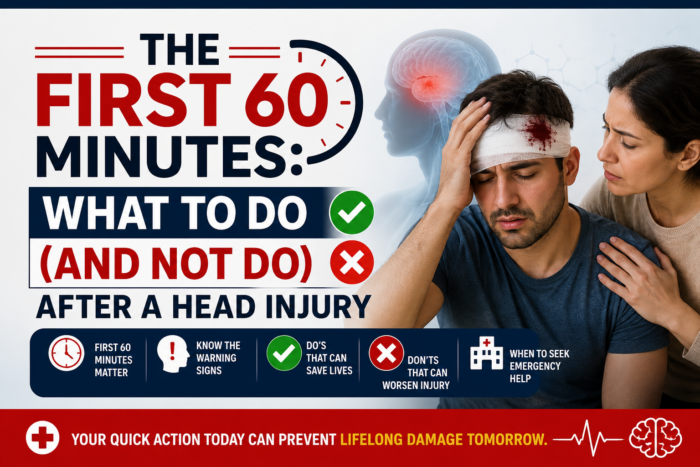
A sudden fall from stairs. A bike collision on the highway. A sports injury during evening practice. Many families ignore early signs because the patient still talks normally. That delay can become life threatening. Understanding what to do after head injury can save brain function, memory, movement and even life itself.
Across Haryana, emergency doctors are reporting increasing cases of untreated trauma reaching hospitals too late. The first hour decides outcomes. Correct head injury first aid and timely medical attention reduce long term complications dramatically. Ignoring mild symptoms often leads to hidden bleeding inside the brain.
Many people dismiss dizziness, confusion or vomiting as temporary weakness. These are dangerous head injury symptoms that require immediate observation. If symptoms worsen suddenly, patients may need urgent surgery by an experienced neurosurgeon in Haryana likeDr. Kavindra Singh. Families searching for reliable head injury treatment Haryana should understand every minute matters after trauma.
The First 60 Minutes After Head Injury Matter Most
The first 60 minutes after head injury are medically critical because swelling and bleeding may develop rapidly.
- Keep the patient awake if possible.
- Check breathing, speech, pupil size and body movement. Never allow unnecessary movement of the neck.
- If the patient becomes confused, sleepy, aggressive or develops seizures, these are immediate signs of serious head injury.
- Start basic brain injury emergency care by placing the patient on one side while waiting for medical transport.
- Families often make the mistake of giving water, painkillers or forcing the person to stand.
A factory worker from Neemrana, Rajasthan slipped from a loading platform and briefly lost balance. His relatives assumed he was stable because he spoke normally. Within forty minutes, he developed severe vomiting and weakness in one arm. He was rushed to Dr Kavindra Singh, neurosurgeon for emergency evaluation. Brain imaging showed internal bleeding requiring immediate intervention. Early arrival prevented permanent paralysis.
First 60 Minutes : Why the Golden Hour Matters
Patients treated within the golden hour often experience:
- Better recovery of speech and mobility
- Lower risk of permanent disability
- Shorter hospital stays
- Reduced rehabilitation expenses
- Faster return to normal life
Quick reporting of allergies, medicines and previous neurological problems also helps specialists make faster surgical decisions during emergencies.
Warning Signs Families Should Never Ignore
Every injury is different. Some patients collapse instantly while others deteriorate slowly over several hours. Understanding when to go to hospital after head injury can prevent irreversible brain damage.
- Persistent headaches, blurred vision, memory loss, slurred speech, repeated vomiting and abnormal sleepiness are severe concussion symptoms. These problems may indicate dangerous pressure inside the skull.
- Parents should also monitor children for unusual crying, imbalance or refusal to eat.
- Another major red flag is loss of consciousness in head injury cases, even if unconsciousness lasted only a few seconds.
- Patients involved in road accidents require immediate observation because delayed bleeding is common.
A resident from Mahendragarh, Haryana suffered a bike accident while returning from work. He reached home instead of visiting a hospital because there were no visible cuts. By midnight, he developed confusion and unequal pupils. His family contacted Dr. Kavindra Singh, the best neurosurgeon in Haryana after learning these were advanced warning signs. Emergency treatment helped stabilize his condition before complications became fatal.
What Not To Do After Head Trauma
Families often worsen injuries unintentionally. Understanding what not to do after head injury is equally important as giving treatment.
- Do not shake the patient forcefully.
- Do not apply pressure on bleeding wounds without proper support.
- Never allow alcohol consumption after trauma.
- Avoid self medication because painkillers may hide neurological decline.
- Driving immediately after injury is also risky.
- During mild head injury care, patients should remain under observation for at least twenty four hours.
- Sudden vomiting, unusual sleep or disorientation require urgent review.
- Doctors also warn families about vomiting after head injury danger signs because repeated vomiting commonly signals increasing brain pressure.
A college student from Dharuhera, Haryana ignored dizziness after falling during cricket practice. Friends advised rest at home instead of hospital evaluation. Overnight, his speech became unclear and he struggled to walk. His parents searched online for a head injury specialist near me in Haryana and reached for emergency head injury consultation with Dr. Kavnidra Singh in time. Prompt head trauma treatment prevented long term neurological disability. Read here about how to recover fast after brain or spine surgery.

Why Choosing the Right Neurosurgeon Changes Recovery
Brain trauma management requires precision, timing and experience. Delayed surgery or wrong assessment may permanently affect speech, memory, movement and personality. Families searching for a trusted brain injury doctor in Narnaul, Haryana or nearby regions often travel for advanced neurosurgical expertise because critical cases demand specialized care. Dr. Kavindra Singh at Rainbow Multi-speciality Hospital & Trauma Center
Why Delays After Head Injury Become Dangerous
In many trauma cases, families lose valuable time calling local healers or waiting for swelling to reduce naturally. Some assume younger patients recover without medical supervision. That mistake can become life threatening within hours.
Brain injuries do not always show visible bleeding. Internal pressure inside the skull may continue rising silently. This is common after:
- Bike accidents
- Falls from stairs or rooftops
- Workplace injuries
- Sports-related impacts
- Sudden road collisions
Children and elderly patients require even faster medical evaluation because the brain reacts differently at these ages.
You can read here how top 6 BRAIN SURGERY MYTHS DELAY TREATMENT.
Mistakes Families Commonly Make
- Giving painkillers without medical advice
- Allowing the patient to sleep continuously
- Ignoring vomiting or confusion
- Delaying scans because the patient is “talking normally”
- Moving the patient roughly after trauma
Doctors handling emergency brain trauma repeatedly warn that symptoms may worsen suddenly after a few hours.
Early Neurosurgical Care Improves Recovery
Timely scans, intensive monitoring and coordinated rehabilitation improve survival and recovery chances significantly after moderate to severe trauma. Across Haryana, more families now prefer experienced neurosurgical evaluation from Dr. Kavindra Singh, because he is the best in the region.
Also, because delayed treatment frequently leads to:
- Coma
- Paralysis
- Memory loss
- Emotional trauma
- Long term financial stress for families
Early expert intervention provides clarity during panic situations. Most importantly, it increases the chances of protecting the patient’s long term independence and quality of life. Rush immediately to Dr Kavindra Singh!
Read here to know HOW TO SAVE A LIFE IN THE FIRST 60 MINUTES OF A BRAIN STROKE.
Patients come to Dr Singh from Haryana, Rajasthan, Punjab and beyond. Sitting at Narnaul at Rainbow Multi-speciality Hospital, Dr. Kavindra Singh has been serving patients across Haryana in all its rural areas as well as cities like Mahendargarh, Rewari, Rohtak and more. And now even accessible in nearby places in both Haryana and Rajasthan like Dharuhera, Bawal, Ateli, Kanina, Kosli, Charkhi Dadri, Bhiwani, Loharu, Jhajjar, Alwar, Behror, Kotputli, Neemrana, Pilani, Chirawa, Singhana and Khetri. The idea is that affordable brain, nerve and spine care reaches all, without going to farther cities like Jaipur, Chandigarh or Gurgaon.