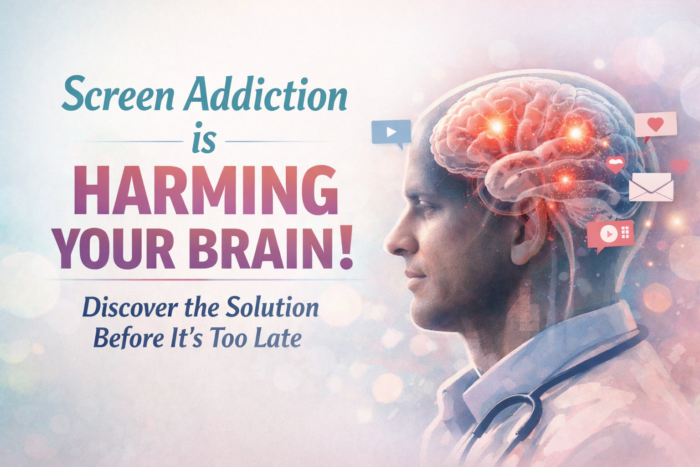
A few days ago, a young businessman sat across me, visibly frustrated. He didn’t come with reports. No scans. No major illness. He simply said, “Doctor, I feel slow… like my brain is not sharp anymore.”
I asked him one question: “How many hours are you on your screen?”
He paused… then said, “Maybe 9–10 hours.” That was the diagnosis. As the most trusted brain health specialist Haryana, these are some real conversations I have almost every day in my clinic. This is exactly how screen addiction effects begin — silently, gradually and dangerously. Mind it, mental health and screen addiction have a very serious relationship.
Screen Addiction in Adults – A Problem that is Exploding
Recent studies show how serious this issue has become:
- According to a report by World Health Organization, excessive digital exposure is directly linked to rising anxiety and cognitive fatigue
- A study published in National Institutes of Health found that adults with high screen time showed reduced attention span and memory retention
- Research from Harvard Medical School confirms that blue light exposure delays melatonin, worsening sleep cycles
What People Think vs What I Actually See
Most people believe screen usage is harmless. “Work hai, social media hai, normal life hai.” But as top neurologist consultation Haryana, I see a completely different reality. I see people who:
- Cannot focus on one task
- Forget basic things
- Feel mentally exhausted without physical work
- Lose confidence in their own thinking
These are not small issues. These are neurological effects of screen time showing up in real life. And the scary part? People normalise it.
How Screen Addiction Is Actually Damaging Your Brain
Let me explain this in the simplest way possible. Your brain is not designed for constant stimulation/ action.
Every scroll, every notification, every reel gives your brain a quick dopamine spike. Over time, your brain gets addicted to this pattern. This is where screen addiction effects on brain become serious.
What changes inside or what are the excessive screen time symptoms?
- Your attention span reduces
- Your brain avoids deep thinking
- Memory formation weakens
- You become dependent on stimulation
This is how the impact of digital devices on brain slowly builds — not overnight, but consistently.
The Symptoms You Are Probably Ignoring Right Now
Let me be very honest here. Most people who come to me already had symptoms… but ignored them. They say things like: “I thought it’s just stress.” “I thought I need more sleep.” These are simple but very serious neurological effects of screen time.
But when I evaluate them, I clearly see excessive screen time symptoms.
In daily life, it shows up as mobile addiction effects on brain. Constant fatigue, even after rest. Difficulty concentrating on simple tasks. Frequent eye strain and headache causes after screen use. Disturbed sleep patterns — classic sleep problems due to screen use.
And the most common complaint I hear now? “I feel mentally blank.”
That is nothing but brain fog due to screen overuse.
An Actual Patient That Should Make You Think Twice
One of my patients, 31 years old, working in IT at Gurgaon, Haryana, came with severe focus issues. Just one pattern — 12 hours of screen exposure daily. Work… then phone… then OTT… then scrolling before sleep.
No disease, no deficiency, but something that seriously needs digital addiction treatment.
This is a classic example of mobile addiction effects on brain combined with growing mental health and screen addiction concerns.
His biggest fear? “I’m losing my edge.” And honestly, he was. That is how the long term effects of mobile addiction begin. It is called brain fog due to screen overuse that is slowly attacking your productivity and confidence.
The Most Dangerous Part – Memory Decline
Let me tell you something very important. The neurological effects of screen time are extremely serious. One of the earliest damages I see is screen addiction and memory problems.
Why? Because your brain stops storing information deeply. You read, but don’t retain. You listen, but don’t process. This is exactly how screen addiction affects brain function. And if ignored, it doesn’t stay mild.
Why This Is Becoming a Bigger Problem Than You Think
Today, people are searching for solutions but not identifying the cause. They search for long term effects of mobile addiction, rather than curtailing the problem, immediately.
They complain about excessive screen time symptoms like:
- Lack of focus
- Poor sleep
- Anxiety
- Reduced performance
- Eye strain and headache causes
But very few realize this is all connected to screen addiction effects on brain. If you keep ignoring it, the condition can escalate to a stage where structured digital addiction treatment becomes necessary. And by then, recovery is slower. That’s my experience not just as the brain health specialist Haryana, but as the top trained doctor from AIIMS Delhi.
How I Help Patients Reverse This
Now the most important question — can this be reversed? Yes. I’ve seen it happen. But only when people act on time. As a brain health specialist Haryana, I don’t give unrealistic advice. I give practical steps that people can actually follow.
Step 1: Start With Awareness, Not Elimination
The biggest mistake people make is trying to quit screens completely. It doesn’t work. Instead, I tell my patients — observe your usage first. Understand where your time is going. That’s the first step toward how to reduce screen time in adults.
Step 2: Break the Dopamine Cycle
Your brain needs to relearn patience. Shift from instant rewards to delayed rewards. Simple changes like reading, walking, or even sitting without your phone help your brain recover from screen addiction effects.
Step 3: Repair Your Sleep
If your sleep is damaged, your brain cannot recover. Most patients I see have severe sleep problems due to screen use. Late-night scrolling is one of the biggest reasons. Fix your sleep and you’ll see visible improvement in mental clarity within days.
Step 4: Train Your Brain Again
Your brain is adaptable. But you have to train it towards safe mental health and screen addiction. I recommend certain activities reverse the impact of digital devices on brain over time.
- Deep reading (not scrolling)
- Focused work sessions
- Writing things down
When You Should Not Delay Anymore
Screen addiction is not just about wasting time. It is slowly changing how your brain works. Ignoring screen addiction effects today can cost you your productivity, decision-making ability and above all, your mental stability.
Over time, I’ve seen patients develop:
- Severe attention disorders
- Chronic anxiety and burnout
- Early cognitive decline patterns
- Dependence on constant stimulation
And the worst part — it feels “normal” until it becomes serious. Consult the best brain doctor in Haryana at Narnaul, If you are experiencing:
- Memory issues
- Constant brain fog
- Low focus
- Mental fatigue
You should not wait. At this stage, you need a proper neurologist consultation Haryana with me. I’ve seen many cases where early intervention made recovery fast and complete.
My Personal Note to You
I’m Dr Kavindra Singh, one of the most trusted brain doctor in Haryana at Narnaul. And I say this with complete responsibility — your brain can recover, but only if you act on time. Don’t ignore the signs. Don’t normalize the symptoms. Because once your brain slows down, every part of your life is affected. And I’ve seen that happen far too often.
You can talk to me freely anyday because I am the most affordable neuro consultation near me Haryana by clicking here.
Why Choose Dr Kavindra Singh Top Brain Specialist in Haryana
Not every doctor will connect these symptoms to brain health. That’s the gap.
You need someone who understands both:
- Behavioral patterns
- Neurological impact
Dr Kavindra Singh, focuses specifically on identifying early-stage brain dysfunction caused by modern lifestyle habits like screen overuse. This is why patients who come early recover faster — because the problem is identified correctly.
Call Dr. Singh Today for Digital Addiction Treatment
Stop searching endlessly for a “neuro consultation near me Haryana” and get clarity from someone who deals with these cases daily. Book a neurologist consultation Haryana today with Dr Kavindra Singh, best brain doctor in Haryana at Narnaul. CLICK HERE FOR APPOINTMENT.
Sitting at Narnaul, Dr. Kavindra Singh has been serving patients across Haryana in all its rural areas as well as cities like Mahendargarh, Rewari, Rohtak and more. And now even accessible in nearby places in both Haryana and Rajasthan like Dharuhera, Bawal, Ateli, Kanina, Kosli, Charkhi Dadri, Bhiwani, Loharu, Jhajjar, Alwar, Behror, Kotputli, Neemrana, Pilani, Chirawa, Singhana and Khetri.
The idea is that affordable brain, nerve and spine care reaches all, without going to farther cities like Jaipur, Chandigarh or Gurgaon.